

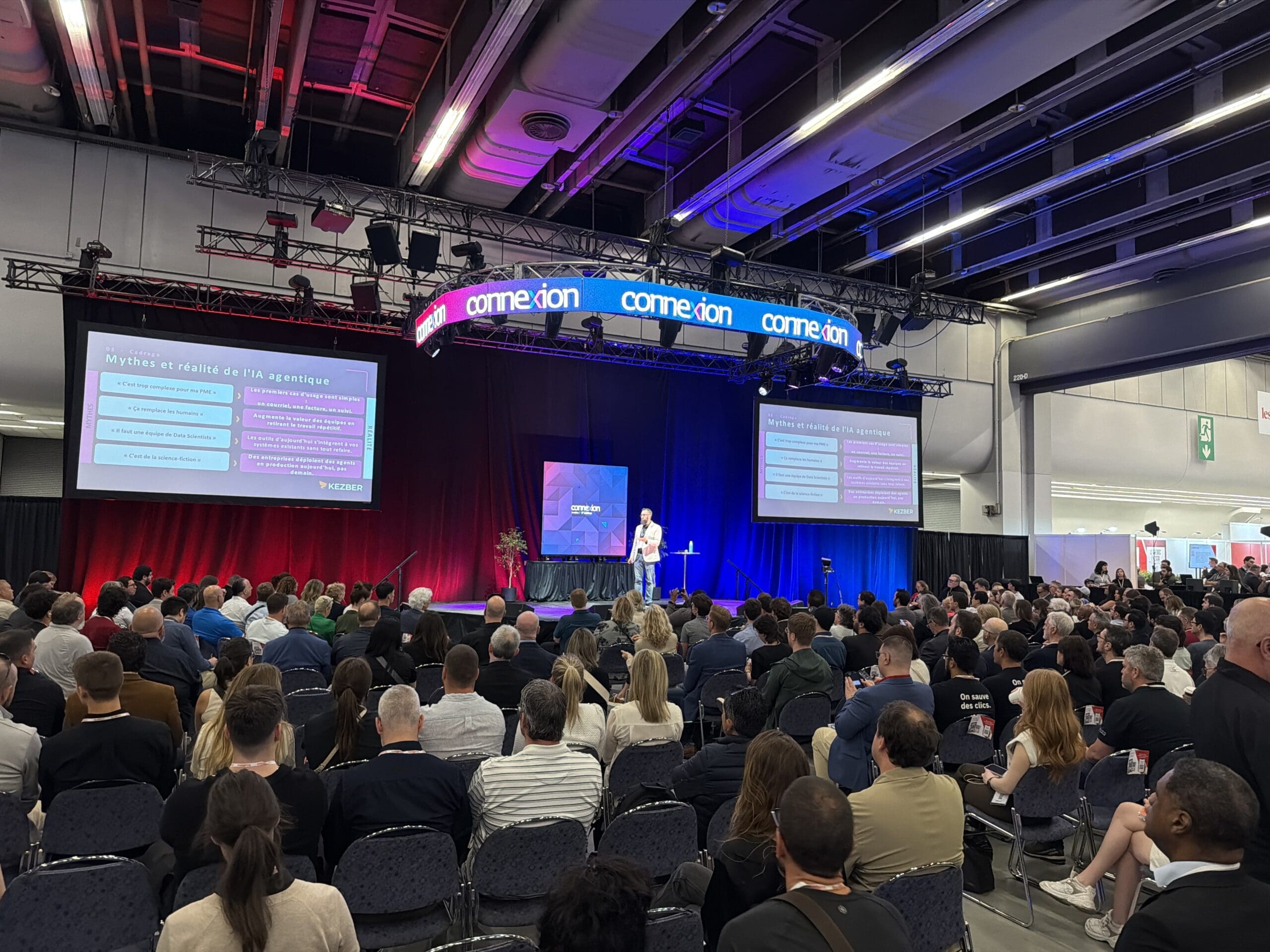

Last week, the Espace M team stepped away from their usual screens to explore the aisles of the Connexion 2026 digital transformation conference. The goal? To take the pulse of the industry’s best practices, gain inspiration, and, above all, bring back concrete learnings to evolve our own workflows.
In an advertising ecosystem where artificial intelligence is on everyone’s lips, adopting it simply to follow the trend is not an option. Our objective is to use it strategically to make our methods even smarter and more efficient, always to the ultimate benefit of our clients.
Here are the key takeaways from this intensive day:
Our 4 key takeways
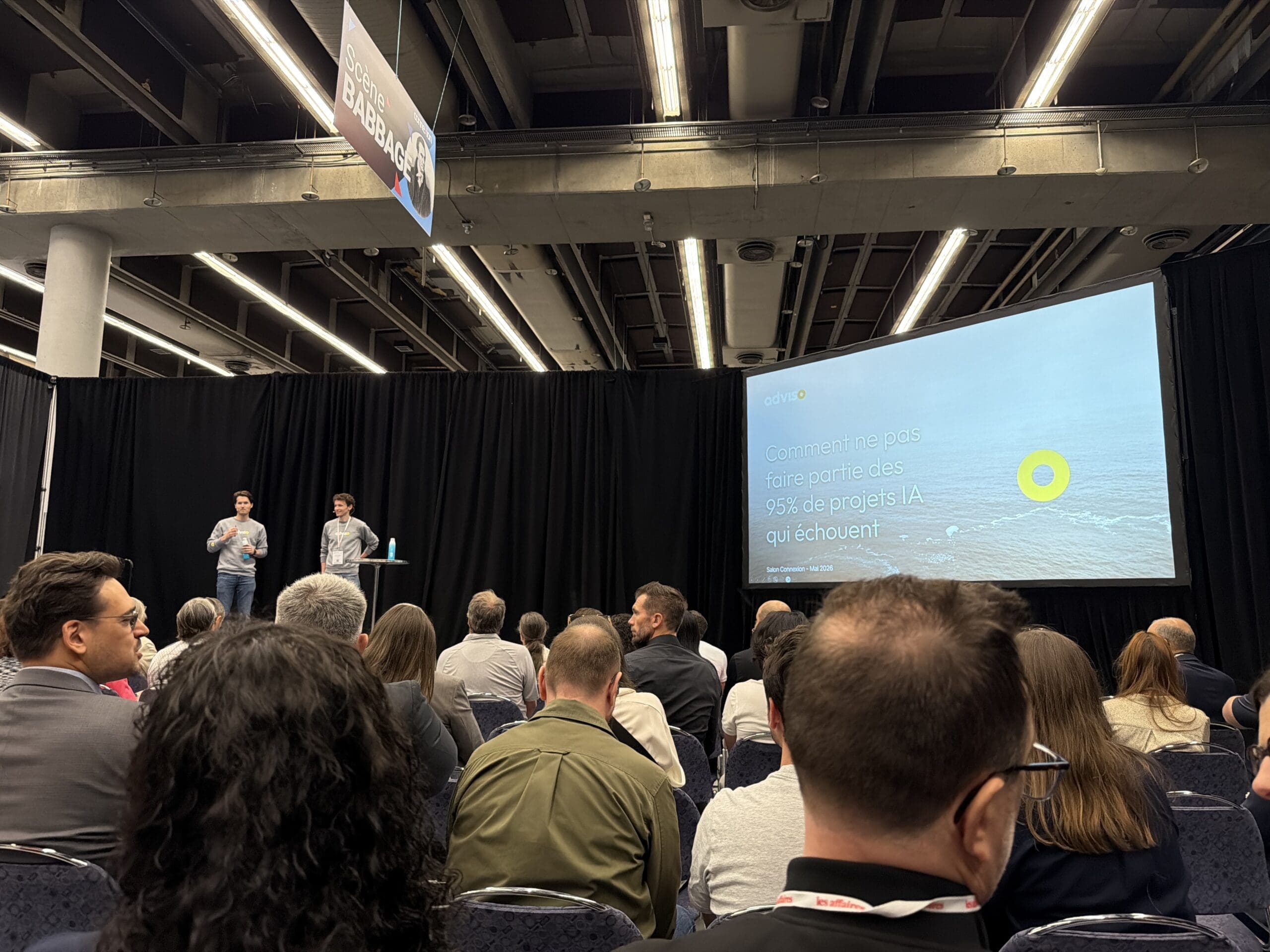
1. The Great Paradox: Why Do 95% of AI Projects Fail?
The reality check shared by industry experts is striking: while initiatives are multiplying, 95% of generative AI projects in companies fail to demonstrate a measurable financial return on investment in the short term. Even worse, in Canada, 42% of projects are abandoned along the way.
Why such a wide gap between technological promise and reality?
- The trap of disorganized “bottom-up” experimentation: Launching pilot projects in every direction without structure or clear business goals inevitably leads to team burnout.
- The lack of measurement infrastructure: Success cannot be evaluated without understanding the starting point (baseline) from day one and tracking real improvements.
- No data, no AI: More than 60% of projects will be abandoned by the end of the year due to a lack of data that is ready, structured, and cleaned.
Our Vision: An AI project is not a purely technological project; it is a business project and, above all, a human journey. To generate real value, algorithms must be guided and framed by the internal expertise of our team members. User feedback is also essential for the successful integration of these new tools.
2. Generative AI vs. Agentic AI: Taking Action
An essential clarification was made during the sessions regarding the major shift currently taking place: the transition from generative AI to agentic AI.
Unlike a simple chatbot that passively waits for a human prompt, an agentic system takes ownership of a defined global objective, interacts with third-party tools, possesses persistent memory, and automates entire workflows (such as managing email flows or processing an order).
Generative AI ➔ Responds to a request ➔ Human initiative (e.g., Writing an email)
Agentic AI ➔ Takes on an objective ➔ Shared initiative (e.g., Managing an inbox)
What We Put into Practice: Start small, measure rigorously, and then scale up. The accessibility of these tools allows us to automate repetitive, low-value tasks right now, freeing up time for more strategic work for our clients.
3. The Shocking Truth: “AI Doesn’t Know How to Count”
This is a critical ground reality that resonates deeply with the daily lives of media planners: a LLM (Large Language Model) is a language model, not a mathematical model.
If you ask an AI to add up or raw-analyze 3,000 rows of data from a Google or Meta ad account, the results will be variable and often riddled with errors.
To get reliable performance analysis, it is imperative to structure the AI by providing it with a strict framework, adapted external calculation tools, and rigorous documentation. Humans must absolutely remain at the center of the loop to supervise, validate, and control deliverables.
4. Performance Marketing Powered by Meta
To close out this day of learning, Meta’s latest updates showcased a vision where AI seamlessly integrates into the daily lives of marketers, notably through its Advantage+ suite.
AI is no longer just an isolated feature; it is becoming the platform itself. Today’s algorithms optimize budgets in real time, adjust creative dynamically, and automatically generate variations tailored to user preferences (automatic translations, customized branding tools). The concrete results speak for themselves, showing median decreases of up to 20% in cost per result (CPA) for sales campaigns.
In Conclusion: Evolving to Better Support You
The ultimate takeaway from Connexion 2026 is that digital maturity cannot be improvised. Measuring the ROI of AI goes far beyond time efficiency or immediate financial gain; it impacts the resilience of our processes and the overall quality of our agency’s deliverables.
We return from this event with a clear roadmap that confirms and enriches our existing AI game plan. By integrating these best practices, embracing the healthy friction that comes with learning new tools, and rigorously protecting data sovereignty, we ensure that our daily work remains human, highly strategic, and resiliently performance-driven.
This article was co-writen with Steve Richer