

How do some brands manage to sustain growth year after year while reducing their reliance on performance-driven tactics?
In today’s increasingly volatile environment, many marketing and media decisions are driven by short-term performance metrics; ROAS, cost per conversion, cost per lead, conversion rates. As a result, pressure is often placed on immediate profitability. In this context, brand awareness is frequently perceived as harder to measure, less attributable, and more abstract. When budgets are rationalized, brand investments are often the first to be reduced in favour of tactics that deliver immediate returns. This dynamic is reassuring, but it carries a long-term risk.
So how should marketers structure their media investments to support both short-term performance and long-term growth?
To answer this question, it is helpful to revisit the foundations of advertising effectiveness and explore how these principles translate into brand strategies, such as the case of Airbnb.
Finding the Right Balance: Brand/Performance
For several years, researchers have explored a central question in marketing: how do advertising investments contribute to brand growth in both the short and long term?
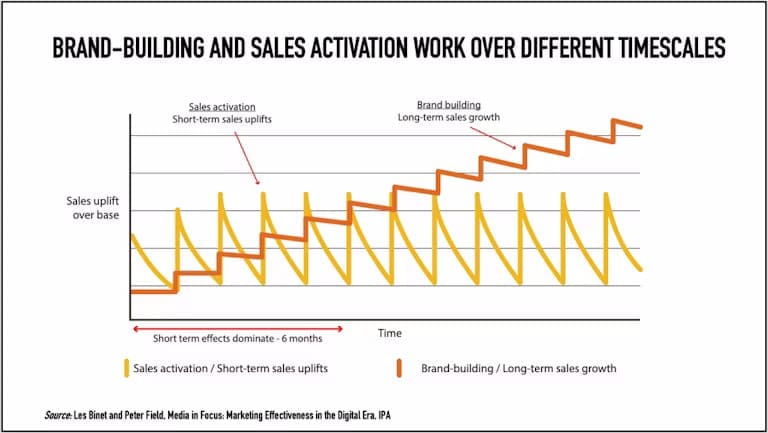
Among the most influential works are the studies by Les Binet and Peter Field. By analyzing hundreds of successful campaigns within the Institute of Practitioners in Advertising database, they identified a consistent pattern: the most effective long-term strategies combine brand building and sales activation.
From this research emerged the well-known 60/40 rule, which suggests that, on average, 60% of investment should be allocated to brand building, while 40% should support short-term activation tactics.
Brand-building campaigns aim to strengthen awareness, perception, and preference. They typically rely on more emotional formats designed to embed in consumers’ memory. The work of the Ehrenberg-Bass Institute also shows that a brand’s growth partly depends on its “Mental availability”: that is, the probability that a consumer spontaneously thinks of a brand at the moment of purchase (“top-of-mind”).
On the other hand, activation tactics (such as search, retargeting, or promotional campaigns) aim to generate immediate action: clicks, visits, or sales. They are highly effective at capturing existing demand, but their growth potential remains limited if the brand has not previously invested in creating that demand.
It is precisely in this complementarity that the 60/40 model becomes powerful. Brand investments expand the potential market and strengthen mental availability, while activation tactics convert demand when it materializes.
That said, the 60/40 ratio should be viewed as a strategic benchmark rather than a one-size-fits-all rule. The optimal balance can vary depending on several factors, including brand maturity, awareness levels, product category, competitive dynamics, and business objectives.
For example, an emerging brand might invest more in awareness to increase its visibility, while an already well-established brand might dedicate a larger portion of its budget to activation to capture existing demand. Similarly, some categories with a short purchase cycle may require a greater emphasis on performance.
After the theory, let’s now look at how this principle can be applied concretely through the example of a brand like Airbnb.
Sources cited:
The Long and the Short of it: Balancing Short and Long-term Marketing Strategies – Les Binet & Peter Field – Institute of Practitioners in Advertising, 2013
Mental availability is not awareness, brand salience is not awareness
When it Comes to Brand Building, Awareness is Critical
How Airbnb Successfully Increased Its Revenue by 61% by Focusing on Brand Awareness Tactics
The Airbnb marketing case illustrates how building a strong brand can transform advertising investments and achieve double-digit growth.
For several years, the platform mainly deployed digital acquisition and performance tactics to accelerate its growth and capture existing demand. In addition to investing in advertising, the brand gradually built and established itself through several factors: a distinctive value proposition and user experience, strong media coverage (PR), word-of-mouth. Over time, Airbnb has become more than just a booking platform, it embedded itself in popular culture. Today, many consumers go directly to Airbnb when planning a trip, making it a natural reflex in the booking journey (a clear example of “top of mind”).
The turning point came during the 2020 pandemic. Faced with a drop in global travel, Airbnb significantly reduced its performance marketing spend. Despite this reduction, platform traffic remained relatively stable. This situation revealed that the majority of visits already came from direct or organic sources.
According to Airbnb CEO, Brian Chesky, this period led to a fundamental shift in how the company views marketing. Rather than “paying to acquire customers,” Airbnb now sees marketing as a way to educate the market, build awareness, and stimulate demand over the long term. In this model, performance tactics are used more selectively, to balance supply and demand, while brand investments take on a more significant role for a long-term strategy.
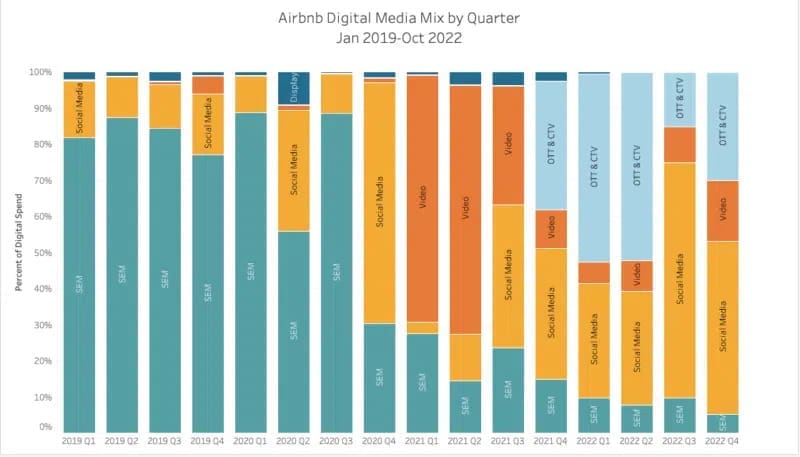
This strategic shift was reflected in the launch of large-scale brand campaigns such as “Made Possible by Hosts,” designed to highlight the host community and the unique experiences Airbnb offers. Early results were compelling: in markets where the campaign ran, traffic increased by nearly 20% compared to pre-pandemic period.
From a revenue perspective, the platform increased its revenue by 61% between the pre-pandemic period (2019) and last year (2025).
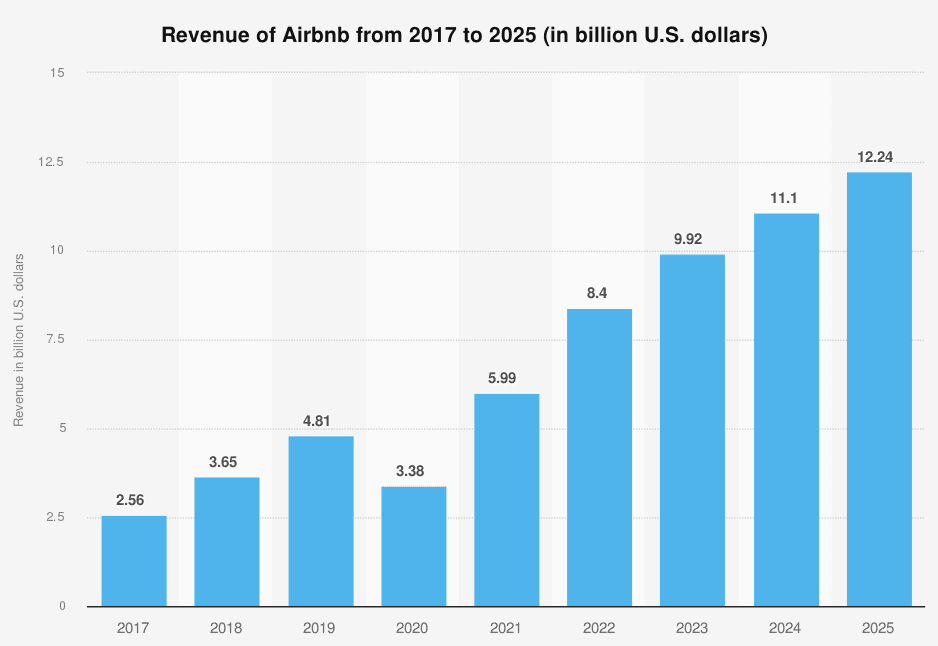
Source: Airbnb; U.S. Securities and Exchange Commission [February 2026]
In addition to awareness campaigns, the brand also relies on its public and press relations, as well as the media coverage they represent. With hundreds of thousands of articles published each year, this visibility reinforces the brand’s presence in consumers’ minds and contributes significantly to direct traffic.
In conclusion, the Airbnb marketing case concretely illustrates media principles, such as the 60-40 ratio. By strengthening brand awareness and mental availability, the company builds a base of demand that makes activation tactics more effective. In other words, brand building does not replace performance marketing, it amplifies it.
Sources cited / Further reading:
Airbnb CFO: We were right to shift spend from performance to brand-building
The best marketing campaigns of 2021: Part 1 / Airbnb – ‘Made Possible by Hosts
Airbnb Says Its Focus on Brand Marketing Instead of Search Is Working
Conclusion: Build Demand to Better Capture It
For both advertisers and agencies, the challenge is not to choose between brand and performance, but to orchestrate their complementarity effectively in order to drive sustainable growth.
Brands that achieve long-term growth are those that invest both in capturing existing demand and in creating future demand.
Key actions to consider:
- Evaluate the current investment distribution: what share of the budget is genuinely dedicated to brand building (awareness)?
- Adapt your media mix to your context: Consider brand maturity, category dynamics, purchase cycle, and business objectives.
- Diversify performance metrics: Complement conversion metrics with brand KPIs such as awareness, consideration, and branded search.
- Think beyond the short term: Measure not only immediate outcomes, but also the long-term effects of brand campaigns