Back in April, Google announced the end of Dynamic Search Ads (DSA) to make way for AI Max. It’s a major structural change for search ad automation. Before jumping to conclusions, here’s a quick summary and a brief look at what’s coming our way.
The transition timeline
Starting in September 2026, Google will begin automatically upgrading DSA campaigns to AI Max. Even though Google promises ‘stable performance’, a massive automatic migration will inevitably mean a settling-in period and some unpredictable fluctuations.
So, it’s a good idea to use the window between now and September to test this transition in a controlled way, rather than just letting it happen to you. This breathing room is really valuable: it gives you a few months to keep an eye on AI Max’s behaviour in your specific setup, spot any potential issues, and adjust before the migration becomes mandatory. The earlier it’s done, the more historical data the algorithm has to work effectively, making for a smoother start in September.
An important note: migrating early isn’t a one-size-fits-all recommendation. Accounts with a solid conversion history and a well-established structure are in a much better position to handle this change. For less mature accounts or those with shaky tracking, rushing into it could totally backfire.
Why this change?
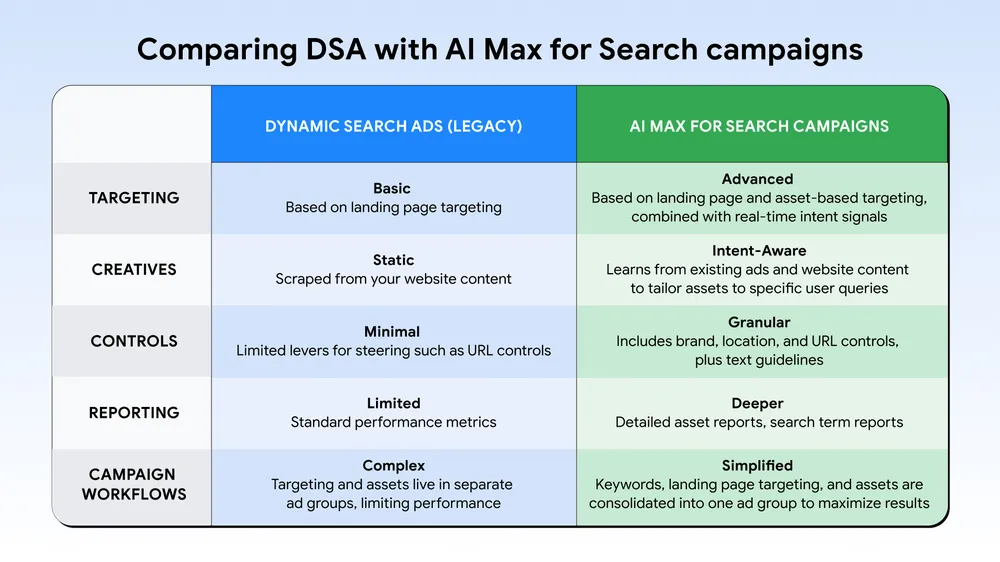
Source : Upgrading Dynamic Search Ads to AI Max for Search, from Google’s official blog.
This change is part of Google’s massive push towards increasingly predictive automation. You also have to look at the bigger picture: the volume of usable keywords is shrinking. Users are typing in longer, more conversational, and nuanced queries—a trend that has grown with the rise of AI search tools like Google AI Overviews, Gemini, or ChatGPT.
In this environment, traditional search inventory based on exact keywords is becoming less and less representative of real user behaviour. To really get the scale of this change, it helps to look back at what each technology actually does.
DSA campaigns in brief
Originally, to run an ad, an advertiser had to guess every single term customers might type into Google. It was a massive job, and advertisers could easily miss out on some really good keywords.
Google then created Dynamic Search Ads to simplify this process: instead of guessing keywords, the tool directly “reads” your website to understand what you’re selling, and then generates dynamic text ads on its search network. It was pretty handy for websites well-optimised for SEO with tons of pages.
Why it was simpler for advertisers
- Automatic updates: if you added a product to your site, the ad was created automatically.
- Custom headlines: Google created a headline that matched the exact search terms and linked it to the right page on your site.
- Massive time saver: no more listing and testing thousands of keywords.
The limits that emerged over time
- Intelligence limited to site content: if a user expresses an intent that your site doesn’t explicitly mention, the DSA misses it.
- Ads can be a bit mechanical sometimes: pure scraping leaves very little control over tone or style.
- Silo management: DSA often runs separately from other campaigns, which fragments the data.
- Lack of visibility: DSA reporting is limited: you don’t always know what triggered what.
AI Max campaigns in brief
After automating targeting with DSAs, Google is taking things a step further with AI Max. The idea is no longer just about finding the right keyword, but using AI to decide where and how to deliver your message based on the user’s actual intent.
Important to note: AI Max isn’t a new standalone campaign type. It’s a feature layer that you activate inside an existing Search campaign. It relies on three components: search term matching (AI-driven broad targeting), text customisation (automatic asset generation), and final URL expansion (dynamic choice of landing page).
What this changes for advertisers
- Advanced contextual targeting: the AI analyses thousands of real-time signals (behaviour, time, device, intent) to tailor the message to the user.
- Dynamic ad generation: headlines and descriptions are generated from your site and existing ads, but with the option to exclude up to 25 terms and 40 message restrictions to protect your brand image.
What we lose, or what’s really changing
Google isn’t making this switch because DSA stopped working, but because it wants to move from reactive to predictive automation. However, we need to be realistic about what that actually implies:
- Less granular control: DSA was predictable. You gave it a URL, it read the text, and it created the ad. AI Max adds several layers of intelligence that make its behaviour less deterministic.
- Final URL expansion: AI Max encourages Google to choose the best landing page itself based on the user, cutting down your control over how the ad and page match up.
- Mixed independent results: Google claims an average 7% improvement in conversions at a similar CPA/ROAS, but you’ve got to take this figure with a pinch of salt. It compares full AI Max against AI Max in search term matching mode only, not directly against DSA.
Grey areas that deserve our attention
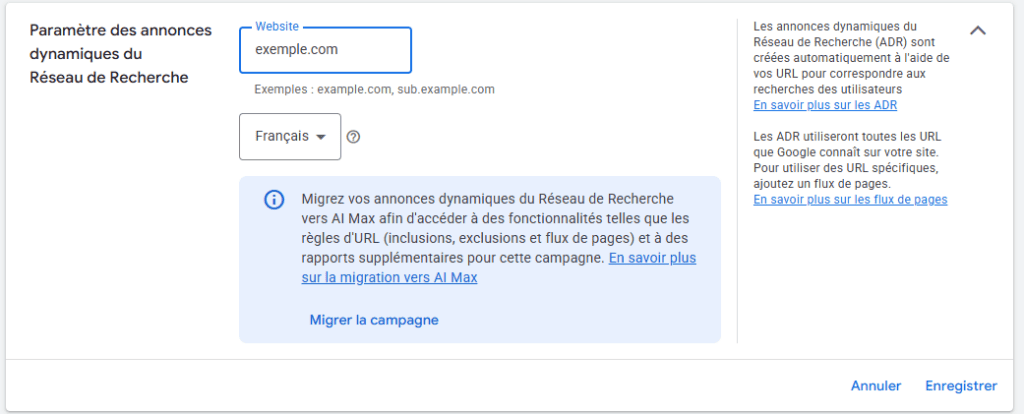
There are two practical questions that Google hasn’t really cleared up yet at this stage.
1. Where do the keywords come from for purely DSA campaigns?
DSA groups don’t have keywords, yet they become standard groups after the migration. So, what is AI Max actually leaning on?
Google transfers the history of converted queries as “seed signals”, keeps reading the pages you set up (your URL rules are preserved), and blends it all with real-time intent signals via its language models, whereas DSA did simple word matching.
That’s also why migrating early makes sense for accounts with a solid history: the more data there is to transfer, the better the starting point. For smaller accounts, Google lets you add keywords manually, which isn’t a minor detail in this case.
2. What happens with mixed campaigns (DSA + standard)?
Good news for mixed campaigns: there’s no need to worry about AI Max activating at the global campaign level. Only the dynamic ad groups move over to standard ad groups, with the three AI Max features turned on specifically inside those groups. Your standard ad groups, with their own keywords, stay untouched. AI Max is actually a set of features activated à la carte, only where the old DSA options used to be. It’s not a global switch that flips your whole campaign.
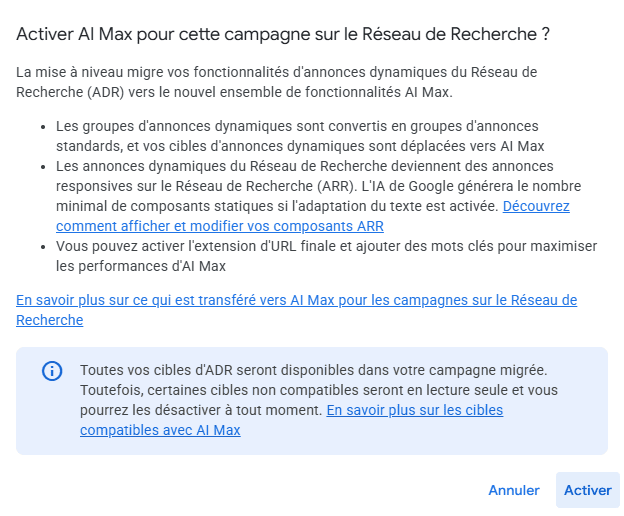
Should you migrate right now?
The answer isn’t one-size-fits-all. The period between now and September is a testing opportunity, not an alarm bell forcing you to change everything right away.
The biggest risk with AI Max is turning it on in existing campaigns without a test phase, as it can mess up your account structure and muddy your reporting. The safest way to migrate is to create a standalone AI Max campaign to directly replace a paused DSA campaign, keeping the test isolated at first.
If your account foundations are solid—meaning reliable conversion tracking, enough historical data, and a clear structure—now is a great time to experiment in a controlled way and gather insights before September.
If those basics aren’t in place, rushing the migration just to “stay in control” will likely just cause confusion with no real benefit.
To sum up
The phasing out of DSAs marks the end of an exact keyword-focused approach in favour of intent targeting. It’s a logical evolution given how search behaviour is changing, but that’s no reason to jump in headfirst without prepping. Test, measure, and above all, ask yourself the right questions about your campaign structure before Google asks them for you in September.