


Part 2: Our GEO Audit Checklist
Remember when smartphones broke the web?
You had a site that looked great on a desktop. Then mobile showed up and everything fell apart. Buttons were too small. Pages loaded slowly. Text was hard to read. Brands that adapted early stayed visible. Brands that waited… disappeared.
You’re in that moment again. But this time, it’s not about screen size. It’s about AI search.
In October, we explained why search is changing and how GEO (Generative Engine Optimisation) is the new layer on top of SEO. This is Part 2: the How — the practical steps you can take this week to make sure AI systems can find, trust, and mention your brand. If you want the definitions and the fan-out concept, read Part 1: Think SEO Is Dead? Meet GEO.
Who is this for?
If you rely on search to get leads, sales, or bookings, this is for you. Whether you are a local service business, a B2B firm, or an eCommerce brand, the rules of the game have changed. AI tools now answer questions before people ever click a link:
- Google AI Overviews: Summaries at the top of search results.
- ChatGPT: The conversational assistant millions use to find answers.
- Perplexity: A dedicated “answer engine” built for speed.
- Apple Intelligence: AI moving directly into the mobile experience.

Phase 1: The GEO Technical Audit
Before we improve your content, we must ensure you can be found and understood. Think of this as clearing the path for your message. If the bots can’t get in, your content doesn’t exist.
1) Indexing and Crawl Access
You need to check the basics of your digital home. If a search engine cannot “crawl” or read your page, an AI cannot use it to answer a question.
- Check your sitemap: Are all key service and location pages listed? Your sitemap is the “table of contents” for crawlers; if it’s outdated, you’re invisible.
- Verify Google indexing: Use Google Search Console to ensure your most important pages are indexed. If Google isn’t seeing them, neither is the AI.
- Audit Robots.txt: Ensure you aren’t accidentally blocking important sections. This is the most common “self-inflicted” wound in SEO.
- Check Canonical tags: Point AI to the “master” version of your URLs. Duplicate content confusion is the fastest way to lose authority in the eyes of AI search.
2) Site Speed and Technical Health
AI systems and users both reward fast, stable sites. Speed is no longer a “nice to have”—it is a foundational requirement for modern search.
- Optimise for speed: Slow pages lead to fewer crawls. The AI might give up before it reads your best points. Aim for high scores in Core Web Vitals, specifically targeting Largest Contentful Paint (LCP).
- Fix broken paths: 404 errors lead to lost trust. If an AI hits a dead end, it marks your site as unreliable and moves on to a competitor.
3) Check Your Firewall and Robots.txt (The “Invisible Wall”)
Even if your SEO looks perfect, your firewall might be slamming the door. This is a common issue for brands using high-level security like Cloudflare or AWS.
- Review “Bot Fight” settings: Firewalls often have “AI Scraper” toggles turned on by default. These can block reputable AI crawlers before they even reach your site. Because this happens at the “edge,” the AI never even sees your site.
- Whitelist reputable AI bots: Ensure that bots like GPTBot (OpenAI), ClaudeBot (Anthropic), and PerplexityBot are on your “Allow” list. Robots.txt sometimes block all bots other than SERPs like Google, Bing, etc. We want you to be secure, but not invisible to the engines that drive recommendations.
4) Verify Your SSL Certificate (The Trust Barrier)
This is a silent killer for AI visibility. Most AI tracking tools and LLM crawlers are programmed to be extremely cautious.
- The Risk: If your SSL certificate is expired, self-signed, or “unrecognised” by certain security protocols, AI bots will simply stop. They won’t scan your site, and they won’t use your data.
- What to do: Ensure your SSL is valid and issued by a recognised authority. If an AI tool throws back a “security warning” error, your content is essentially locked away from the AI ecosystem.
5) Add LLMS.txt (An AI-Friendly Content Map)
Think of LLMS.txt like a “read this first” note for AI systems. It is a simple file that helps us point LLMs directly to your best pages and official brand facts.
The Early Adopter Advantage: While the llms.txt standard is still in its early adoption phase, the industry is moving fast. It is far smarter to have your “AI roadmap” ready now than to scramble to set one up once it becomes a mandatory standard.
- Surface “Hidden” Content: Much like Schema, an llms.txt file serves as a safeguard for content that might otherwise be lost inside JavaScript elements like accordions, tabs, or “read more” overlays. By providing these text snippets directly in the file, you ensure the AI sees your most important data without having to “render” complex code.
- Include your core identity: Start with a short, 2-sentence description of who you are and what you do.
- List key URLs: Link directly to your service pages, locations, contact, pricing, and FAQ.
- Highlight trust signals: Don’t forget your “About” page. This helps the AI connect your brand to real people and history. Author pages are great too if you have them.
6) Validate Structured Data (Schema)
Schema is the language that machines speak. It removes the “guesswork” from the equation.
- Verify your code syntax: Ensure your JSON-LD code is valid and has no errors. Even a missing comma can break the whole script.
- Use the right tools: Use the Google Rich Results Test to verify your markup. If it doesn’t pass here, it won’t be used by the AI.
- Audit placement: Check that schema exists on your service, location, and FAQ templates. It must be consistent across the entire site.
7) Cookie Notice: Keep Policy Text out of the Popup
Many cookie banners inject a huge wall of legal text right into the page code. While this satisfies legal teams, it creates “noise” for AI.
- The Issue: For AI and crawlers, this legal jargon often sits “above” your real content in the code, making the page harder to summarise.
- The Fix: Keep the popup short (1–2 lines) and link to your full policy pages instead. This ensures the AI sees your value proposition before it sees your legal disclaimers.

Phase 2: How to Create Content AI Will Actually Use
In Part 1, we talked about answering real questions. Now, let’s look at the “how”—the actual strategy for writing content for citations.
1) Write “Mini-Answers” That Can Be Quoted
You don’t need a giant FAQ page for this. A mini-answer can live anywhere—your homepage, your service pages, or your local landing pages.
- The H3 Question Pattern: Make your heading a real question your customer would ask. “How much does [Service] cost in [City]?” is better than “Pricing Info.”
- The Direct Answer: Put a short, clear answer (2–3 lines) directly under that heading. Avoid “corporate speak”—answer it like you’re talking to a friend.
- The Detail: Put the longer explanation and proof underneath.
2) Use Facts AI Can Verify
AI trusts content that matches other credible signals on the web. It is essentially looking for “triangulation.”
- Define your service areas: List exact areas by neighbourhood and city. This builds “Local Authority.”
- Provide brand proof: Include credentials, certifications, and warranties. If you are an “Award-Winning” firm, link to the award source.
- Show real work: Use real photos of your team and projects. AI is getting better at “reading” images to verify that you are a real, boots-on-the-ground business.
3) Integrate Specific Schema Types
Remove the guesswork for AI systems by using the right labels on the right pages:
- LocalBusiness: Essential for any brand with a physical footprint. It tells the AI your hours, address, and phone number.
- FAQPage: This is the “holy grail” for AI citations. It provides clear, liftable answers that Google loves to use in AI Overviews.
- Product: For eCommerce brands, this ensures your prices and stock levels are accurately reflected in search.

Phase 3: Fighting AI Hallucinations
Remember the “fan-out” effect we mentioned in our first article? The major difference between classic search and AI Search is that LLMs are “generating” answers. They scrape info from multiple places—old reviews, outdated directories, or social media posts that aren’t yours. This leads to hallucinations (when machines make stuff up).
1) Create One “Source of Truth” Page
Create a page that lists your official “Company Facts” or “Services and Policies.” Think of this as the “Internal Wikipedia” for your brand. Link to it from your footer and your “About” page. This gives the AI a primary, high-authority place to go when it finds conflicting info elsewhere.
2) Maintain Data Consistency
Your website must match your Google Business Profile, your LinkedIn, and your local directories. Inconsistent data invites the AI to make a guess—and it usually guesses wrong. If your hours change, they must change everywhere on the same day.
3) Use FAQs to Prevent Wrong Assumptions
If a customer asks it, the AI will ask it too. Anticipate the “hallucination triggers” by adding FAQs about your travel fees, emergency hours, and exactly what is included in your standard service.
Phase 4: Monitoring Your AI Reputation
You cannot “set and forget” your GEO strategy. You must watch what the AI says about you with the same intensity you watch your online reviews.
1) Leverage Your Existing SEO Stack
Standard tools like SEMrush and Ahrefs have recently introduced “AI Prompt Tracking” or “Brand Radar” features. These are great for getting a “directional” sense of your visibility within the platforms you already pay for. However, because AI moves faster than traditional indexes, these tools can sometimes under-report your true presence.
2) Use Advanced GEO Specialists
If your brand presence is critical, you need tools that mimic real user behaviour rather than just checking APIs. The leaders in this specialized space are:
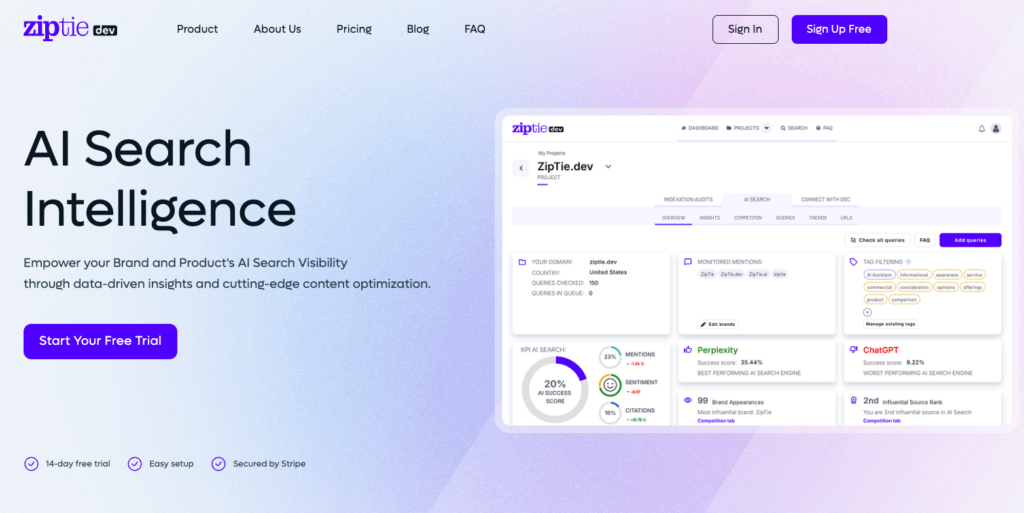
- Ziptie.dev: Widely considered the gold standard for high-frequency tracking of Google AI Overviews and ChatGPT citations. It often detects up to 10x more AI mentions than traditional SEO tools.
- Profound: An enterprise leader that monitors 10+ AI search engines and uses advanced sentiment analysis to see how your brand is being described.
3) Audit AI Accuracy
If the AI is wrong, don’t get mad—get fixing. Go back to your website and make the correct information even more prominent. Add a “mini-answer” that addresses the specific hallucination. Over time, the AI will re-crawl and correct its model based on your “Source of Truth.”
The GEO Priority Matrix
Not all tasks are created equal. If you only have one hour this week, here is how to prioritise your mission:
| Priority | Task | Why it matters |
| Critical | Firewall, Robots.txt & SSL Check | If the door is locked, the AI can’t even see your “Source of Truth.” |
| High | Schema & Mini-Answers | These are the primary data sources AI uses to quote and cite you. |
| Medium | LLMS.txt | Great for early adoption and surfacing “hidden” accordion content. |
| Ongoing | AI Reputation Monitoring | Essential for catching “hallucinations” before they become reality. |
Your Next Steps
The early movers in the “smartphone moment” won the decade. The early movers in GEO will win this one. This week, we recommend taking these five steps:
- Run a technical audit: Check your indexing, site speed, SSL status, and specifically your firewall/CDN settings.
- Add an LLMS.txt file: Surface your “hidden” accordion content and guide the AI bots to your most important facts before they wander off-site.
- Validate your schema: Use the Google Rich Results Test to ensure your code is perfect.
- Create your “Source of Truth”: Give the machines a single page they can trust above all others.
- Monitor your brand: Start with manual prompts, check your SEMrush/Ahrefs reports, or explore a specialist tool like Ziptie.dev to see your true share of voice.
Ready to act?
If you want to know where you stand, we can run a quick GEO check and show you exactly what to fix first.
Book your free discovery call today and find out if SEO is the missing piece to your marketing strategy!